
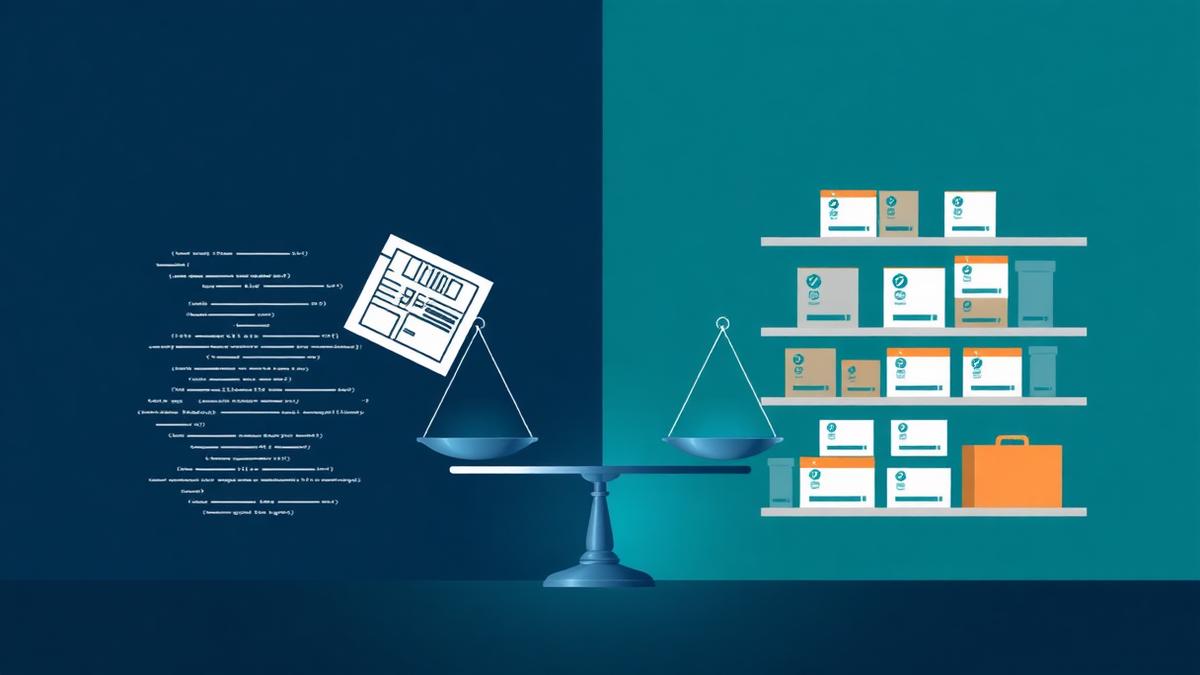
When to Build Custom and When to Buy Off-the-Shelf
Every business eventually faces a version of this decision: there is a software need, there are commercial products that partially address it, and there is the option of building something specifically designed for the way the business operates. The choice between custom software development and an off-the-shelf solution is one of the more consequential technology decisions a company makes — and one of the most frequently made on incomplete reasoning.
The conversation tends to start with cost. It should start with fit.
Why the Off-the-Shelf Default Is Often Reasonable
Commercial software exists because common business problems are genuinely common. Sales pipeline management, HR administration, project tracking, invoicing — these processes are similar enough across most businesses that a well-developed product handles them adequately for the majority of users. Off-the-shelf solutions carry other advantages: they are available immediately, they come with established support structures, and the cost is known upfront.
For a business with standard processes and limited resources to invest in technology, buying an established product is often the correct decision. The operational risk is low, the implementation timeline is predictable, and the ongoing cost is manageable.
The off-the-shelf default becomes a problem when the business applies it indiscriminately — selecting commercial products for processes that are not standard, then spending significant time and money on configuration, workarounds, and integrations that attempt to make the product behave like something it was not designed to be.
Where Off-the-Shelf Solutions Break Down
The critical failure mode with commercial software is process contortion. When a business structures its workflows around the constraints of a product rather than the logic of its operation, the cost surfaces gradually: in the time teams spend working around limitations, in the data that cannot be captured because the system does not support it, in the integrations that are technically possible but practically fragile.
There are several specific conditions under which off-the-shelf software consistently underperforms:
- The business operates a process that is genuinely differentiated — one that reflects a competitive advantage or a way of working specific to the industry or business model
- The data structure required does not map cleanly to what commercial products assume
- The process involves multiple systems that need to exchange data in ways that standard integrations do not support
- The volume or complexity of the process means that manual workarounds create meaningful operational risk
- Regulatory or compliance requirements demand specific data handling that commercial products do not accommodate
In these cases, the question is not whether custom development is expensive. It is whether the ongoing cost of the wrong tool is being accurately calculated.
What Custom Development Actually Involves
Custom software development is not the right answer because it produces something bespoke. It is the right answer when the business process it supports is specific enough that a designed solution will outperform any configured one over a meaningful time horizon.
A well-scoped custom development project begins with a detailed requirements process — not a technology specification, but a thorough documentation of the process the software needs to support.
How NormaTech Approaches Enterprise Application Development
NormaTech's approach to custom enterprise application development is grounded in the premise that software exists to serve a business process, not to demonstrate technical capability. The starting point is always the process analysis: what does the business actually need the software to do, and is a custom solution genuinely the right answer.
When custom development is the right path, NormaTech designs and builds applications that are aligned with the client's operational structure, integrated with their existing systems, and built to be maintained and extended without dependency on a single vendor. The development process is transparent; clients see working software at regular intervals and have the opportunity to adjust direction before the full investment is made.
NormaTech also applies this rigor to scope control. A custom application that expands continuously during development is a common source of cost overrun and delayed delivery. NormaTech defines scope clearly at the outset and manages change through a structured process rather than accumulating requirements informally.
What the Decision Framework Looks Like
The build-or-buy decision can be reduced to a few practical questions:
- Does a commercial product handle this process without significant configuration or workarounds?
- Will the business still be running this process the same way in three to five years, or is it likely to evolve in ways that a commercial product may not accommodate?
- Does the process represent something the business does differently from its competitors — something that should be systematized on its own terms?
If the answers point toward customization, the follow-up question is not whether custom development is affordable. It is whether the business has the clarity to specify what it needs and a development partner with the discipline to build it correctly.
Off-the-shelf software is the right default for standard processes. When the process is not standard, defaulting to it anyway is a decision with a compounding cost.
Expert Opinion
"First, make sure you actually understand your own process clearly. Sometimes just thinking it through properly reveals that an off-the-shelf tool would work fine. There are often ready-made solutions already out there — and one might fit your needs perfectly. The key is doing proper research and discovery to find what exists, what fits your situation, and what it costs compared to building from scratch. If you do go custom, it should be because your needs are genuinely unique and the software will save or earn you enough money to justify the cost — not just because an existing tool felt limiting without anyone doing the math."
— George Maisuradze, Founder of NormaTech
If you are evaluating whether a process in your business warrants a custom solution, the right starting point is a structured assessment of what the process requires and what the alternatives actually cost over time. NormaTech can run that analysis with you before any development decision is made.